
Josie avoided scoliosis surgery. Here's how.
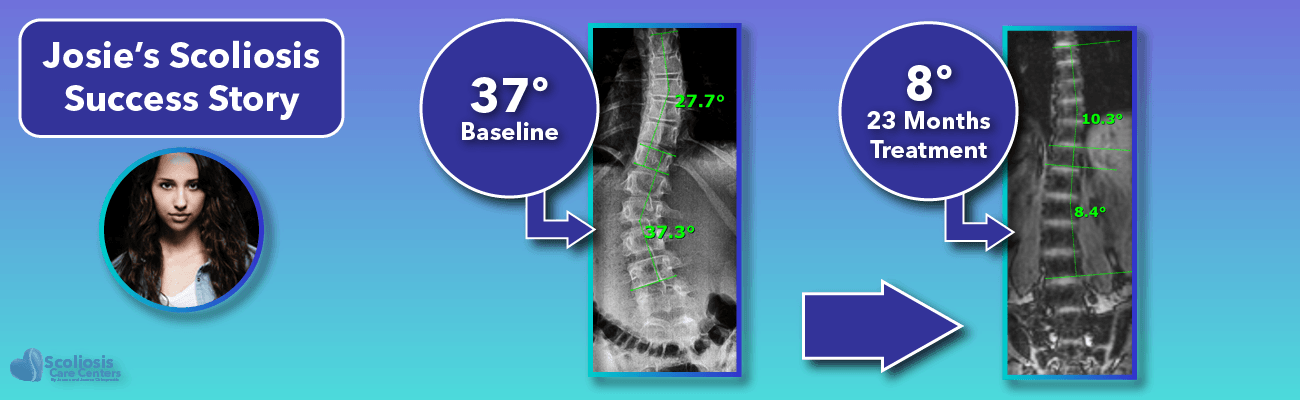
Josie was diagnosed at 9 and told to wait and see. A year later, her curve was just below surgery range. Today it's about 9°, under the 10° line for scoliosis.
Her story is also a short lesson in how scoliosis works, so you know what to look for with your own child.
- Age 9Wait and seeDiagnosed with scoliosis and told to watch it for a year.
- A year laterNear surgery rangeThe curve had grown. Josie and Darci wanted to avoid spinal fusion if at all possible.
- TreatmentThe workSpinal weighting exercises, nerve stretching and the Silicon Valley Brace™.
- 5 years laterAbout 9°Below the 10° threshold for scoliosis.
Told to wait and see
Josie was diagnosed with scoliosis when she was 9. Like many families, she and her mom, Darci, were told to wait and see.
A year later, Josie's curve had grown to just below surgery range.
Just below surgery range
Josie and Darci wanted to avoid spinal fusion surgery if at all possible. To know how close they were, it helps to know how a curve is measured.
Finding Scoliosis Care Centers
After a few days of research, Darci found Scoliosis Care Centers. She liked that our treatment was non-surgical and looked at the whole picture.
A week later, they flew from Michigan to California to start.
Hard work pays off
Josie kept up with her exercises and nerve stretching, and wore her Silicon Valley Brace™.
Five years later, her curve is about 9°, below the 10° threshold for scoliosis. Along the way she kept playing volleyball, pursued modeling and finished school.
Three things to take with you
Don't just watch during growth.
The growth years are when a curve is most likely to change, for better or worse.
Know your child's numbers.
The curve size, growth stage and age together tell you much more than any one of them.
Ask how a treatment corrects.
Holding a curve where it is and helping it improve aren't the same goal.
Three numbers that shape your child's risk
Questions to ask your child's doctor
- What is my child's Cobb angle now, and what was it last time?
- What is the Risser sign? How much growing is left?
- What's the plan if the curve grows during the next growth spurt?
- If we brace, how much does the curve correct inside the brace?
- How will we keep track of it, and how often?
- Is there anything we can do now, instead of waiting?
Want help with your child's numbers?
Start with a free case review. We'll look at your child's curve, growth stage and age, explain what they mean, and talk you through the options. No commitment.
Every child's curve is different, and not every case turns out like Josie's. See average results by curve size or read more success stories. Prefer to talk? Call (833) 557-2654.